DOMINATE THE ASVAB
530 practice questions covering all 9 ASVAB subtest scores. Timed tests. Detailed explanations. Progress intel. Built for future warfighters.
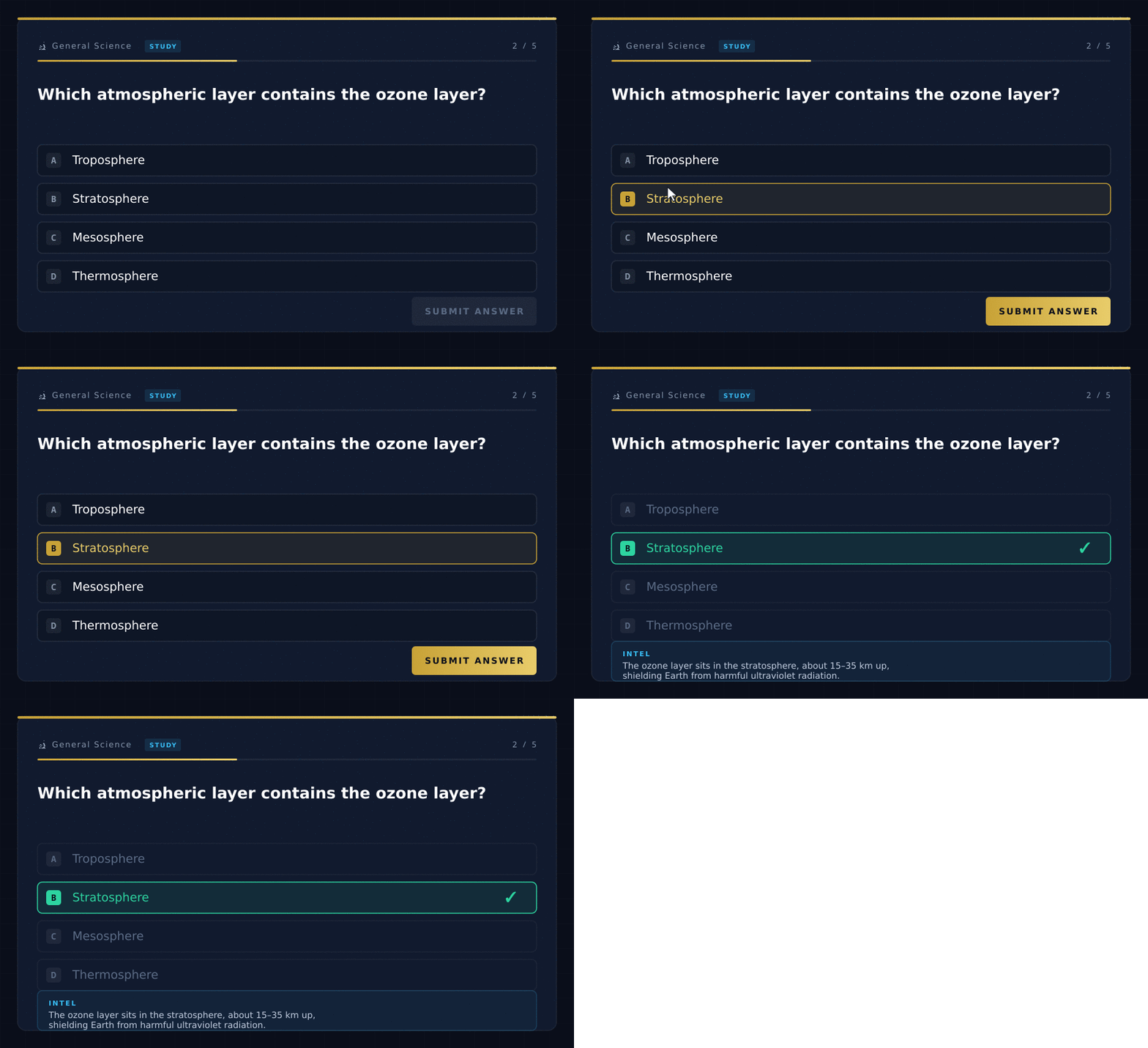
Study smarter — instant explanations
Free to start — no credit card required.
AFQT Subtests
Determines EligibilityThese four subtests form your AFQT score — the score that determines if you qualify for enlistment in the U.S. Armed Forces.
Arithmetic Reasoning
ARSolve arithmetic word problems involving real-world scenarios
Word Knowledge
WKUnderstand word meanings through synonyms and context
Paragraph Comprehension
PCObtain information from written passages and make inferences
Mathematics Knowledge
MKHigh school mathematics including algebra and geometry
Technical Subtests
These subtests determine your qualification for specific military occupations (MOS, AFSC, NEC, Rating).
General Science
GSLife science, earth and space science, and physical science
Electronics Information
EIElectrical current, circuits, devices, and electronic systems
Auto & Shop Information
ASAutomotive maintenance, repair, and shop tools and practices
Mechanical Comprehension
MCMechanical and physical principles including simple machines
Assembling Objects
AOSpatial reasoning and visualizing how objects fit together
Minimum AFQT by Branch
| Branch | HS Diploma | GED |
|---|---|---|
| Army | 31 | 50 |
| Marines | 31 | 50 |
| Navy | 31 | 50 |
| Air Force | 31 | 50 |
| Coast Guard | 32 | 50 |
| Space Force | 31 | 50 |
AFQT is reported as a percentile from 1 to 99 — the share of the 1997 national reference sample of 18–23 year-olds you outscored — not a percentage of questions answered correctly.
Minimums as of July 2026 (source). Services raise and lower these standards with recruiting conditions, and individual jobs, waivers and education tiers carry their own requirements. Your recruiter's current standard governs — confirm before you rely on this table.
Retesting: you may retest one calendar month after your initial ASVAB, then one further calendar month before a second retest; any retest after that requires a six calendar month wait. ASVAB scores remain valid for enlistment for two years from the test date.
About the ASVAB
The Armed Services Vocational Aptitude Battery (ASVAB) is a multiple-choice battery used by the U.S. military to determine qualification for enlistment and for specific jobs. It measures aptitude across verbal, math, science/technical and spatial domains, and is reported as 9 subtest scores. The computer-adaptive version administers those as 10 separately timed tests, because Auto Information and Shop Information are given apart and only their result is combined; the paper version administers 9, with Auto & Shop as one test. Either way you receive 9 scores — which is what this site covers.
The AFQT score (Armed Forces Qualification Test) is what decides whether you may enlist at all, and it comes from four of those subtests: Arithmetic Reasoning, Mathematics Knowledge, Word Knowledge and Paragraph Comprehension. The composite is AR + MK + (2 × VE), computed on standard scores (mean 50, standard deviation 10) rather than on raw right-answer counts.
VE is Verbal Expression, and it is not a sum: it is its own scaled score derived from your Word Knowledge and Paragraph Comprehension results by a published regression in which PC carries roughly two-thirds the weight of WK, because PC is the shorter and less reliable of the two tests. The resulting composite is then converted through a published table into the 1–99 AFQT percentile — your standing against a 1997 national sample of 18–23 year-olds. That last conversion is the step that gives the number its meaning: an AFQT of 50 means you scored better than half of that reference group, not that you answered half the questions correctly.
The CAT-ASVAB is taken at MEPS and adapts item difficulty to your answers. The average examinee finishes in about an hour and a half; the 10 sections carry 197 minutes of time limits in total (135 questions), which is the ceiling rather than the expectation, since the adaptive test ends after a fixed number of items instead of running the clock down. The paper-and-pencil version is the long one — 225 questions and 149 minutes of testing time, closer to three hours once administration is included. No calculators are permitted on either.